NEJM
Perspective
|
Richard Ambinder, M.D., Ph.D.
The persistence of the eponyms "Hodgkin" and "Reed�Sternberg" and the noncommittal descriptor "disease" underscores the uncertainties long associated with the multinucleated giant cells that Sternberg believed to be a manifestation of infection and Reed believed to be malignant. In fact, it is now clear that several infections are closely linked with lymphomagenesis. These include Epstein�Barr virus (EBV) in a variety of lymphoproliferative diseases, human T-cell leukemia virus type 1 (HTLV-1) in adult T-cell leukemia�lymphoma, Helicobacter pylori in gastric mucosa-associated lymphoid-tissue lymphoma, and hepatitis C virus in splenic lymphoma with villous lymphocytes.
Broadly speaking, the infectious agents associated with lymphoma fall into at least two categories: those that activate lymphocytes through their antigen receptors and those that bypass antigen receptors and instead activate intrinsic pathways within lymphocytes. Agents in the first category include bacteria as well as viruses. Hepatitis C virus and H. pylori appear to drive the proliferation of B cells in an antigen-specific manner, and treatment with anti-infective agents sometimes results in tumor regression. In contrast, agents in the second category are exclusively viruses such as HTLV-1 and EBV, which induce the proliferation of infected lymphocytes as part of the viral life cycle.
In this issue of the Journal, Hjalgrim et al. (pages 1324�1332) bring clarity to the association of EBV infection with Hodgkin's lymphoma. Refinements in molecular techniques have removed all doubts about the origin and character of the Reed�Sternberg cells in classic Hodgkin's disease � they are neoplastic cells of B-cell lineage. They differ from most other B-cell�lineage lymphomas in that, although they carry immunoglobulin genes that have undergone the rearrangements that should allow them to produce immunoglobulins, they do not express or produce immunoglobulins. Hence, any infectious agent associated with Hodgkin's lymphoma must activate an intrinsic pathway.
In approximately one third of cases, the Reed�Sternberg cells and their variants harbor EBV episomes (genetically active elements) and express viral genes (see Figure). Several products of these genes � the latent membrane protein (LMP) 1, the EBV-encoded RNA transcripts, and perhaps the BamHI-A transcripts � have been implicated in aspects of malignant transformation. The possible contribution of the LMP-2A has only recently been identified (see Figure). Expression of LMP-2A in B cells in transgenic mice allows immunoglobulin-negative cells that would otherwise undergo apoptosis to escape death and persist, suggesting that LMP-2A promotes the survival of these cells in the absence of signaling through the B-cell receptor.
|
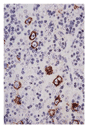
As noted by Hjalgrim et al., infectious mononucleosis has long been recognized as a risk factor for Hodgkin's lymphoma. However, EBV expression is demonstrable in only a minority of cases of Hodgkin's lymphoma in North America and Western Europe. Thus, the question is whether EBV is associated with all cases of Hodgkin's lymphoma or only those in which EBV expression can be demonstrated in Reed�Sternberg cells. A causal association of EBV with all cases of Hodgkin's lymphoma is not implausible. EBV is ubiquitous, with serologic evidence of infection in more than 90 percent of adults. EBV infection of a premalignant cell might initiate tumorigenesis, perhaps by causing genetic instability or some other change that ultimately renders the viral genome superfluous to the maintenance of the malignant state.
In contrast with many other tumor viruses whose genetic material becomes integrated into host-cell DNA, the loss of viral episomes is well documented in EBV-positive tumor-cell lines. Thus, the virus might "hit and run." Hjalgrim et al. found that acute EBV infection is associated with an increased risk of EBV-positive Hodgkin's lymphoma, but not of EBV-negative Hodgkin's lymphoma. There is strong evidence in the aggregate to support the concept that EBV infection has a role in the pathogenesis of Hodgkin's lymphoma, but no evidence to support the hit-and-run theory.
The findings of Hjalgrim et al. have increased our understanding of the relation between EBV and Hodgkin's lymphoma, but many questions remain. For example, familial Hodgkin's lymphoma is well documented, but both EBV-positive and EBV-negative Hodgkin's lymphoma can occur within a family. Hence, it is not appropriate to presume that EBV-positive and EBV-negative Hodgkin's lymphomas are distinct entities. At present, it appears that there are several paths to Hodgkin's lymphoma and that they all must involve signals that allow lymphocytes of B-cell lineage that do not express immunoglobulin to escape apoptosis. Thus, it might be possible to devise cancer-prevention or early-diagnosis strategies for use in patients with infectious mononucleosis.
Source Information
From Johns Hopkins School of Medicine, Baltimore.
References
- Murray PG, Constandinou CM, Crocker J, Young LS, Ambinder RF.
Analysis of major histocompatibility complex class I, TAP expression, and
LMP2 epitope sequence in Epstein-Barr virus-positive Hodgkin's disease.
Blood 1998;92:2477-2483.
[Abstract/Full Text]