NEJM
Perspective
|
Rodger L. Bick, M.D., Ph.D.
Thrombosis was identified as a complication of cancer by Trousseau in 1865, and the combination of the two conditions is still often called Trousseau's syndrome. Arterial and, more commonly, venous thrombosis is a frequent complication of cancer and sometimes a harbinger of occult cancer. Moreover, the use of new and aggressive therapy for cancer increases the risk of thrombosis.
There are many causes of thrombosis in cancer. Cancer itself is often the underlying mechanism. When cells of the monocyte or macrophage lineage interact with malignant cells, they release tumor necrosis factor, interleukin-1, and interleukin-6, causing endothelial damage and sloughing of endothelial cells and thereby converting the vascular lining over which blood flows to a thrombogenic surface (see Figure). The interaction between tumor cells and macrophages also activates platelets, factor XII, and factor X, which leads to the generation of thrombin and thrombosis.
|
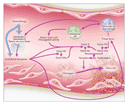
Substances in tumor cells such as cysteine proteases and tissue factor (often referred to as cancer-cell procoagulants) have procoagulant, or thromboplastin-like, activity. These procoagulants can directly activate factor X (to factor Xa), whereas tissue factor, including that released by monocytes or macrophages, induces the direct activation of factor VII (to factor VIIa). The sialic acid moieties of mucin from adenocarcinomas cause a nonenzymatic activation of factor X.
Aggressive antitumor therapy with such commonly used agents as platinum compounds, high-dose fluorouracil, mitomycin, tamoxifen, and growth factors (granulocyte colony-stimulating factor, granulocyte�monocyte colony-stimulating factor, and erythropoietin) increases the risk of thrombosis. The underlying mechanisms are poorly understood, but many of these therapeutic agents induce vascular damage. Despite a decade of study, it is not known how tamoxifen induces thrombosis.
Central venous catheters, commonly inserted for chemotherapy and hyperalimentation, are also associated with a risk of thrombosis and embolism. The thrombogenic surface of these catheters can activate platelets and serine proteases, such as factors XII and X. Moreover, gram-negative organisms that infect central venous catheters can release endotoxin, and gram-positive organisms can release bacterial mucopolysaccharides. These bacterial polysaccharides can activate factor XII, induce a platelet-release reaction, and cause sloughing of endothelial cells; each of these activities increases the risk of thrombosis. Endotoxin also induces the release of tissue factor, tumor necrosis factor, and interleukin-1, which can incite thrombogenesis.
The past three decades have heralded the arrival of thromboprophylaxis in a variety of forms, including antiplatelet agents, low-dose warfarin, standard-dose warfarin, and low-dose unfractionated heparin. Therapy for thromboembolic disease has most commonly consisted of standard-dose heparin followed by low-dose or standard-dose warfarin; however, this approach has been notoriously ineffective and is associated with unacceptable risks of bleeding in patients with cancer.
In this issue of the Journal, Lee et al., on behalf of the Randomized Comparison of Low-Molecular-Weight Heparin versus Oral Anticoagulant Therapy for the Prevention of Recurrent Venous Thromboembolism in Patients with Cancer (CLOT) investigators, provide compelling evidence of an effective and safe approach to thromboembolic disease in patients with cancer (pages 146�153). In this well-designed, multicenter study, 672 patients with cancer and symptomatic proximal deep-vein thrombosis, pulmonary embolism, or both were randomly assigned to receive the low-molecular-weight heparin dalteparin (Fragmin, Pharmacia) at a therapeutic dose of 200 IU per kilogram of body weight given subcutaneously once daily either for five to seven days, followed by six months of therapy with standard-dose warfarin (target international normalized ratio, 2.5), or for one month, followed by a reduced dose of dalteparin (approximately 150 IU daily). The incidence of recurrent thromboembolism in the dalteparin group was half that in the warfarin group (occurring in 27 of 336 patients, as compared with 53 of 336). The probability of recurrent thromboembolism at six months was 9 percent in the dalteparin group and 17 percent in the warfarin group. The incidence of major bleeding in the two groups was not significantly different: 6 percent in the dalteparin group and 4 percent in the warfarin group.
The use of low-molecular-weight heparins for the treatment of or prophylaxis against thromboembolic disease in patients with cancer or other conditions has been limited by a number of issues, primarily reservations about the cost and the risk of hemorrhagic complications. The choice of dalteparin by the CLOT investigators was wise, since a meta-analysis of comparisons of a variety of low-molecular-weight heparins with unfractionated heparin for deep-vein thrombosis1 showed that dalteparin was associated with fewer major bleeding episodes and a lower mortality rate than unfractionated heparin or any other low-molecular-weight heparin available in North America. An additional benefit is that dalteparin, unlike others of its type that are available in North America, has been deemed safe for use in the elderly (those older than 65 years of age) by the Food and Drug Administration.
The cost of low-molecular-weight heparins has been overestimated. It is unnecessary to monitor the anticoagulant effect of these heparins, except in some patients with renal insufficiency, and the reduction in recurrences reduces the overall cost of medical care, easily compensating for the difference in cost between low-molecular-weight heparin and unfractionated heparin and in the cost, over a six-month period of prophylaxis, of monitoring the international normalized ratio in patients who receive warfarin. The multicenter trial reported by Lee at al. provides clear evidence that low-molecular-weight heparin should become the therapeutic and prophylactic agent of choice in cancer-associated thromboembolic disease.
Source Information
From the Dallas Thrombosis�Hemostasis Clinical Center, University of Texas Southwestern Medical School, Dallas.
References
- Dolovich LR, Ginsberg JS, Douketis JD, Holbrook AM, Cheah G. A
meta-analysis comparing low-molecular-weight heparins with unfractionated
heparin in the treatment of venous thromboembolism: examining some
unanswered questions regarding location of treatment, product type, and
dosing frequency. Arch Intern Med 2000;160:181-188.
[Abstract/Full Text]