Perspective
NEJM
|
Thomas A.E. Platts-Mills, M.D., Ph.D.
The evidence that allergens found inside houses are an important cause of perennial rhinitis and asthma comes from three types of studies. In one type, the delivery of allergen in the laboratory has provoked the clinical condition; in another type, the avoidance of allergens has been shown to result in fewer symptoms of disease; and the third type examines the epidemiologic association between the prevalence of disease and sensitization to particular allergens. These results lead logically to two different forms of allergen-specific treatment: immunotherapy, in which the physician tries to induce tolerance to a given allergen, and avoidance of allergen.
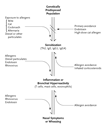
In a world in which medical management is dominated by pharmacologic treatment, it is important to have other options for both patients and physicians; allergen avoidance is such an option. The case for the avoidance of dust-mite allergen as a treatment for asthma comes from controlled trials in patients' homes and from experiments in which patients were transferred to a sanatorium or an "allergen-free" hospital room. In those studies, the patients had impressive decreases in the severity and frequency of symptoms, medication requirements, and in nonspecific bronchial hyperreactivity (see Figure).
|
The authors of the two negative reports in this issue of the Journal hoped that they would be able to show that the placement of impermeable covers on patients' mattresses would provide significant benefit for patients with perennial rhinitis (Terreehorst et al. [pages 237�246]) or asthma (Woodcock et al. [pages 225�236]). These were both well-conducted studies in which the investigators and the patients were, to the extent that it was possible, blinded to the treatment-group assignment. Furthermore, because the investigators did not know which subjects were allergic to dust mites, they could not have known which patients "should have" had improvement. As Woodcock and his colleagues take great care to point out, their study does not show or imply that allergen avoidance should not be recommended for patients with asthma who are allergic to dust mites. What their study shows very clearly is that distributing or recommending allergen-proof covers in a family-practice setting is unlikely to be effective as a single measure in the absence of a comprehensive avoidance strategy. The obvious implication of these studies is that mattress covers as a routine part of the treatment of asthma are not worth the price. However, according to other studies, the correct conclusion is that treatment by means of allergen avoidance requires the definition of what patients are allergic to, additional measures beyond the use of mattress covers, and education.
Many controlled trials are plagued by placebo effects, but such effects are particularly problematic in any study that attempts to change a patient's lifestyle. Delivery of a mattress cover to the family clearly indicates what the study is about, and the family will generally assume that they should do other things to "help." Even if the family members do not know whether they are in the active-intervention group or the control group, they do know that they are in an allergen-avoidance study. Some researchers have gone so far as to argue that an observational group is needed in which no home visit is conducted and no mention of a home intervention is made until the end of the study. Thus, this type of study can have two kinds of errors: either the intervention is inadequate to achieve a clinically significant decrease in exposure to allergens, or the families have made other changes, intentionally or unintentionally, that have a greater effect than the intervention being studied.
Dust mites are not the only agent that can influence lung function. The home environment, apart from the mattress, is an important source of nonspecific irritants as well as other allergens. For example, endotoxin and cat allergen have been demonstrated to affect nasal and bronchial symptoms, and equally important, each of them can be measured in floor dust and is airborne. There is now evidence that each of these agents has a complex role in allergic disease. Endotoxin, which is a potent irritant to the respiratory tract, can help to suppress sensitization if exposure occurs early in life. There is increasing evidence that children raised in a household with a cat are less likely to become sensitized to cat allergen and that very high levels of exposure induce a specific form of immunologic tolerance. By contrast, moderate exposure to cat allergen is sufficient to induce sensitization in a large number of children who have never lived in a household with a cat. These paradoxical findings make it difficult to interpret the results of studies on secondary and particularly primary avoidance (see Figure).
The alternative implication of the current studies is that we do not understand what is necessary to make patients with asthma well, let alone to cure the disease. The currently available pharmaceutical treatments control asthma, but they do not provide effects that last for more than one month after treatment is discontinued. Is it possible that we have missed an element of the experiments in sanatoriums or allergen-free rooms? The conditions in those studies almost certainly included decreased exposure to animal dander, endotoxin, and fungal spores, as well as the decrease in levels of mite allergen. Alternatively, those regimens may have included other changes such as increased physical activity, which is usually possible once symptoms have improved, but which is not part of routine treatment.
What is clear is that some changes in diet, lifestyle, cleanliness, or housing have led to a massive increase in the prevalence and severity of asthma. The challenge is both to identify the changes that are responsible for this increase and to design a treatment approach that makes it possible to prevent or cure the disease. Physicians are very good at prescribing drugs and very poor at effecting changes in behavior, even when the latter are better for the patient. If minor reductions in exposure to allergen are not sufficient, we need either to persuade families to change their living conditions on a large scale or to identify the real cause of the increase in the prevalence of asthma.
Source Information
From the University of Virginia Asthma and Allergic Disease Center, Charlottesville.