 UK
Europe
USA&Canada
Aust.&NZ
Asia
UK
Europe
USA&Canada
Aust.&NZ
Asia
Editorials Online�
Medical
Law News
E-texts
Links
Classifieds
Home
|
|
|
NEJM
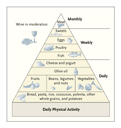
Frank B. Hu, M.D., Ph.D. The concept of the Mediterranean diet originated from the Seven Countries Study initiated by Ancel Keys in the 1950s. The study showed that, despite a high fat intake, the population of the island of Crete in Greece had very low rates of coronary heart disease and certain types of cancer and had a long life expectancy. The traditional dietary patterns typical of Crete, much of the rest of Greece, and southern Italy in the early 1960s were considered to be largely responsible for the good health observed in these regions.1 The main characteristics of the Mediterranean diet (see Figure) include an abundance of plant food (fruits, vegetables, whole-grain cereals, nuts, and legumes); olive oil as the principal source of fat; fish and poultry consumed in low-to-moderate amounts; relatively low consumption of red meat; and moderate consumption of wine, normally with meals.
Over the years, the Mediterranean diet has been promoted as a model for healthy eating. The diet, however, has been surrounded by as much myth as scientific evidence. There is no single "Mediterranean diet." More than 15 countries border the Mediterranean Sea, and their dietary habits, the types of food produced, and their cultures vary considerably. Moreover, the differences that Keys observed in mortality from coronary disease among different populations could well be attributable to confounding by other lifestyle-related factors, such as physical activity. The first clinical-trial evidence in support of the health benefits of
the Mediterranean diet came from the Lyon Diet Heart Study,2
in which 605 patients who had had a myocardial infarction were randomly
assigned to a "Mediterranean-style" diet or a control diet
resembling the American Heart Association Step I diet. Patients in
the Mediterranean-style�diet group were encouraged to consume more
fruits, vegetables, and fish; to eat less red meat; and to replace
butter and cream with margarine rich in More recently, Singh et al.3 tested an "Indo-Mediterranean diet" in 1000 patients in India with existing coronary disease or at high risk for coronary disease. As compared with the control diet, the intervention diet � characterized by increased intake of mustard or soybean oil, nuts, vegetables, fruits, and whole grains � reduced the rate of fatal myocardial infarction by one third and the rate of sudden death from cardiac causes by two thirds. In this issue of the Journal, Trichopoulou et al. (pages 2599�2608) report the results of a population-based study involving 22,043 apparently healthy adults in Greece, in which adherence to a traditional Mediterranean diet was associated with significantly lower total mortality, mortality from coronary heart disease, and mortality from cancer. To measure adherence to this diet, a score was constructed that incorporated relatively high intakes of vegetables, fruits and nuts, legumes, cereals, fish, and monounsaturated fat; relatively low intakes of meat, including poultry, and dairy products; and moderate consumption of alcohol. One intriguing aspect of this study is that despite a robust inverse association between the overall Mediterranean-diet score and mortality, no appreciable associations were seen for most of the individual dietary components used to construct the score. One possible explanation is that the effects of single nutrients or foods may be too small to detect, whereas the cumulative effects of multiple dietary components may be substantial. In addition, there may be synergistic or interactive effects among nutrients or foods, which the score automatically takes into account. Although the Mediterranean-diet score predicted the risk of death, dietary components that were not considered by Trichopoulou et al. may also be important in determining the health effects of a diet. For example, trans fatty acids are an important determinant of the risk of coronary heart disease,4 although the intake of trans fatty acids may have been low in this cohort. Also, recent evidence suggests that higher dietary glycemic load has adverse effects on blood lipids and is associated with an increased risk of coronary disease but that whole grains are beneficial; thus, the effects of "cereal" intake may depend on the degree of processing.4 In addition, the effects of alcohol consumption vary depending on the amount consumed; the "desirable" range in the study by Trichopoulou et al. is considerably wider than that defined in most U.S. studies. Although a higher intake of alcohol has been shown to be protective against coronary disease, it also increases the risk of several types of cancer. Higher levels of consumption of olive oil are considered the hallmark of the traditional Mediterranean diet. For centuries, olive oil has been treasured in Greece and other Mediterranean countries for its healing and nutritional properties. The use of olive oil now extends beyond the Mediterranean region. Cumulative evidence suggests that olive oil may have a role in the prevention of coronary disease and several types of cancer because of its high levels of monounsaturated fatty acids and polyphenolic compounds. Interestingly, in the present study, olive oil was associated with only a small and nonsignificant reduction in mortality, whereas the inverse association between mortality and the ratio of monounsaturated fats to saturated fats was stronger and statistically significant. Other important plant-based sources of monounsaturated fatty acids
include nuts and rapeseed (canola) oil. Monounsaturated fat, whether
from olive oil or other sources, may have the same beneficial effects
on blood lipids and oxidative stress, but this possibility has not
been fully studied. Both the Lyon Diet Heart Study2
and the recent Indian study3 have emphasized
rapeseed, or canola, oil as a source of Dietary patterns in Greece and other Mediterranean countries are changing rapidly, with increased consumption of saturated fat and refined carbohydrates.5 The prevalence of obesity in Greece has increased dramatically, which probably results from the combination of the rapid Westernization of the diet, increased caloric intake, and decreased levels of physical activity. Keys and others have lamented the loss of the "good Mediterranean diet" and called for the reversal of the current dietary trend. The study by Trichopoulou et al. provides another reminder that the preservation of certain dietary and lifestyle traditions may have substantial health dividends for generations to come.
From the Departments of Nutrition and Epidemiology, Harvard School of Public Health, and the Channing Laboratory, Department of Medicine, Brigham and Women's Hospital and Harvard Medical School � all in Boston. References
|
 -linolenic
acid (to mimic the n�3 content of the traditional Cretan diet).
After a mean follow-up of 27 months, the rate of coronary events was
reduced by 73 percent, and total mortality was reduced by 70 percent
in the intervention group.
-linolenic
acid (to mimic the n�3 content of the traditional Cretan diet).
After a mean follow-up of 27 months, the rate of coronary events was
reduced by 73 percent, and total mortality was reduced by 70 percent
in the intervention group.