NEJM
|
Daniel D. Federman, M.D.
Sexual reproduction requires three types of differentiation: gonadal for the production of gametes, genital for the conveyance of gametes to a point of fertilization, and behavioral for the urge to behave sexually. Two articles in this issue of the Journal illuminate several of these steps.
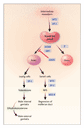
MacLaughlin and Donahoe (pages 367�378) provide a current view of the genetics of gonadal development, describing genes that are responsible for the formation of the urogenital ridge and the migration of germ cells to it, resulting in the formation of a bipotential gonad (see Figure). Defects in the genes that are involved in this process cause infertility and diverse renal and genital anomalies. The best-defined gene involved in gonadal differentiation, SRY, is found on the short arm of the Y chromosome and (with a lot of help) induces the bipotential gonad to differentiate into a testis. SRY and the SOX9 gene that it induces have major roles in this process, with support from steroidogenic factor 1 (SF-1) and opposition from DAX1. Smaller parts are played by WT1 and other genes. Defects in these genes cause the gonadal dysgenesis syndromes, in which a failure of gonadal differentiation is combined with female genital development. Overexpression of DAX induces what is called XY sex reversal, but this term is misleading. Testicular differentiation is prevented, but there is no true ovarian differentiation either. To date, there is no convincing evidence that an ovarian differentiation factor exists.
|
The second phase of preparation for sexual reproduction, genital differentiation, is hormonally mediated. Working through an X-linked androgen receptor, testosterone mediates the positive development of the wolffian ducts into the vas deferens, epididymis, and seminal vesicles. Dihydrotestosterone, which is primarily produced from testosterone in target tissues by the action of 5
 reductase, induces the differentiation of the penis and scrotal sacs.
It uses the same androgen receptor as testosterone does and binds to
it with 10 times the affinity of testosterone. The androgen receptor
is a site of enormous mutability; there have been several hundred
reported cases of complete or incomplete androgen insensitivity.
Patients with such insensitivity have no m�llerian ducts (and antim�llerian
hormone is intact), but the degree of masculinization varies widely
among such patients: they may have none at all, if androgen
insensitivity is complete, or may be normal except for gynecomastia.
In striking contrast, there has been only one reported case of an
estrogen-receptor defect, suggesting that this receptor has a
strategic role in fetal survival.
reductase, induces the differentiation of the penis and scrotal sacs.
It uses the same androgen receptor as testosterone does and binds to
it with 10 times the affinity of testosterone. The androgen receptor
is a site of enormous mutability; there have been several hundred
reported cases of complete or incomplete androgen insensitivity.
Patients with such insensitivity have no m�llerian ducts (and antim�llerian
hormone is intact), but the degree of masculinization varies widely
among such patients: they may have none at all, if androgen
insensitivity is complete, or may be normal except for gynecomastia.
In striking contrast, there has been only one reported case of an
estrogen-receptor defect, suggesting that this receptor has a
strategic role in fetal survival.
Behavioral differentiation has proved to be the most enigmatic of
the three steps. The first component, the sense of oneself as male or
female � which Reiner and Gearhart (pages 333�341) refer to as
sexual identity � is established in most children by two and a half
years of age and in essentially all children by three years. At this
age, sexual identity is separated from sexuality � that comes
later. Sexual identity was long thought to be psychologically derived
through the internalization of social cues given to the infant on the
basis of the appearance of the external genitalia. But this view has
had to be modified. In two disorders, 5-reductase
deficiency and 17 -hydroxysteroid
dehydrogenase deficiency, newborns look predominantly female and
are raised as girls but then have dramatic virilization at puberty.
Many such persons gradually assume a male sexual identity and sex
role. Similarly, there are isolated cases in which male children who
had been raised as female because of a traumatic amputation of the
penis insisted on assuming a male sexual identity and sex role when
they were teenagers or adults. The report by Reiner and Gearhart
describes 8 of 14 genetically male children with severe cloacal
exstrophy who, after being raised as female, later chose a male
sexual identity. Taken together, such evidence points strongly to a
hormonal role in the sexualization of the brain.
-hydroxysteroid
dehydrogenase deficiency, newborns look predominantly female and
are raised as girls but then have dramatic virilization at puberty.
Many such persons gradually assume a male sexual identity and sex
role. Similarly, there are isolated cases in which male children who
had been raised as female because of a traumatic amputation of the
penis insisted on assuming a male sexual identity and sex role when
they were teenagers or adults. The report by Reiner and Gearhart
describes 8 of 14 genetically male children with severe cloacal
exstrophy who, after being raised as female, later chose a male
sexual identity. Taken together, such evidence points strongly to a
hormonal role in the sexualization of the brain.
The remaining components of human sexuality are incompletely understood. Erotic responsiveness and sexual drive or libido in boys and men are, at least in part, dependent on testosterone. Whether estrogen plays a part, as it does in some crucial effects of testosterone, is not clear. But sexual behavior in girls and women is not similarly dependent on estrogen. Indeed, testosterone � again, perhaps along with estrogen � may be an important factor in arousal and drive in women. But intimacy, tenderness, and relationship appear to be important contributors to female sexuality. The final aspect of sexuality, the choice of partners, is virtually terra incognita. For the specific purpose of preserving the race, sexual activity must be heterosexual. But for the manifold goals of love, warmth, and mutuality, other choices are satisfactory.
Another important outcome of evolution is that so-called sex hormones have major roles in somatic tissues as well as in reproduction. Testosterone affects height, body mass, hair growth, muscle strength, bone mass, and lipid metabolism and is probably involved in aggression. Estradiol influences the pubertal growth spurt and growth arrest, bone density, and cardiovascular metabolism and also plays a part in the development of breast and prostate cancer, as well as other conditions. Almost every specialty of medicine recognizes sex differences in the epidemiology, clinical manifestations, course, and treatment of disease. Thus, everyone in medicine should be interested in the effects of sex differences in the earliest stages of development and in the entire course of patients' lives.
Source Information
From Harvard Medical School, Boston.